Massimiliano Mocchia di Coggiola
December 2025
MEET THE BOULEVARDIER
Massimiliano Mocchia di Coggiola carries an atmosphere with him, a quiet gravity that shifts the rhythm of any table he joins. Encounters with him, whether across linen or from behind a counter, leave you with the impression that something rare has happened, something shaped by intention rather than chance. He moves through gatherings with a calm sense of mischief, inviting others to settle, breathe, and notice small pleasures often overlooked. A glass poured with care, a remark delivered at the perfect moment, a glance that encourages conversation to linger. He has a gift for turning ordinary evenings into occasions, not through spectacle, but through presence.
When you share time with him, you are reminded that warmth can be cultivated, that connection can be sincere, and that hospitality, when offered with heart, becomes its own form of artistry. There is comfort in his company, and also curiosity, a sense that another memorable hour is approaching. Below, Massimiliano raises a glass and holds court.
THE MODERN DÉFINITION
Arthur Moss defined a boulevardier in 1927 as “a permanent fun seeker. Their life is a perpetual holiday.” What's your definition?
Today's boulevardier cannot have changed much since 1927. In fact, I believe that if the modern boulevardier had a religion, their martyr saint would be Pierre de Régnier, who died at 40 from épuisement due to excessive drinking and eating. I believe very few people ever saw him wearing anything other than a tuxedo or tails. He wrote articles about Parisian nightlife in the ’30s, emptied bottles, listened to jazz, and drew caricatures on tables. He even wrote a remarkable novel, as well as a guide to Deauville (the best chapter is dedicated to the casino…). His poems are among the most entertaining ever written and are dedicated to Montparnasse, luxury hotels, the girls, and alcohol... So the 21st-century boulevardier is perhaps a bit more bobo, but in the sense of boulevardier-bohemian. It is now difficult to be just an idler without being scolded. Régnier was paid (!) to go out at night, whereas we poor devils also have to pass ourselves off as artists, like bohemians, to justify our fashionable alcoholism.
THE SPARK OF THE CITY
Which street corner, café, bar, or park in Paris constantly sparks your creativity?
I have a misplaced fascination with those corners of the city that speak of its past and continue to be experienced in the same way. Pigalle, certain corners of Montmartre... but also the passages (Vivienne, Panorama, Jouffroy) for their dusty luxury and that somewhat forgotten elegance of old Paris. I often return with pleasure to Le Serpent à Plume in Place des Vosges, a breeding ground of creativity and very modern liveliness that connects to the worldly and international tradition of the city. Le Vaudeville, opposite the old Bourse, with its marble and mirrors. I remain faithful to the rive Droite in any case. I prefer authentic grime to the polished grime of new money made on the rive Gauche.
THE ESSENTIAL DEMANDE
The original boulevardiers demanded “wine and a song” to set the scene. What two things (physical or metaphorical) do you “demand” to keep your life feeling like a perpetual holiday?
Given that, wanting to prove myself a boulevardier too, I need wine and songs. Wanting to add a more personal option, I stay within the realm of the bobo I mentioned earlier and would speak of love. Physical and metaphorical at the same time. Eternal or fleeting, it does not matter. The university boulevardier demands "Bacchus, tobacco, and Venus," and I do not think I am very far from that. And it does not matter if the love I am referring to is then just an evening illusion. We are talking about ghosts to feed, we are talking about bachelor machines, as another great boulevardier, Marcel Duchamp, used to say.
SILENT MUSE
Describe the single, most elegantly designed object at your desk or in your studio that affects your concentration and creative workflow.
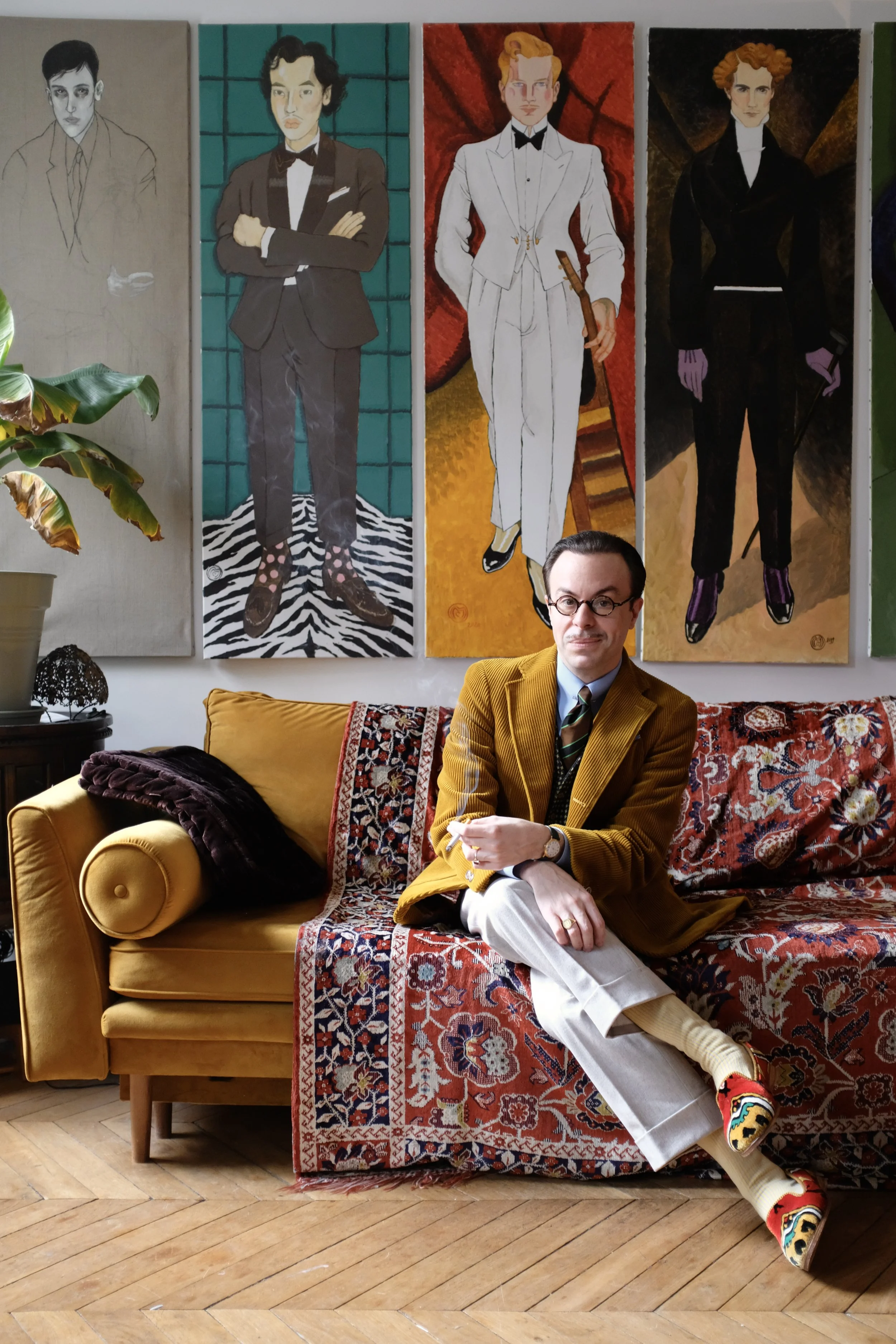
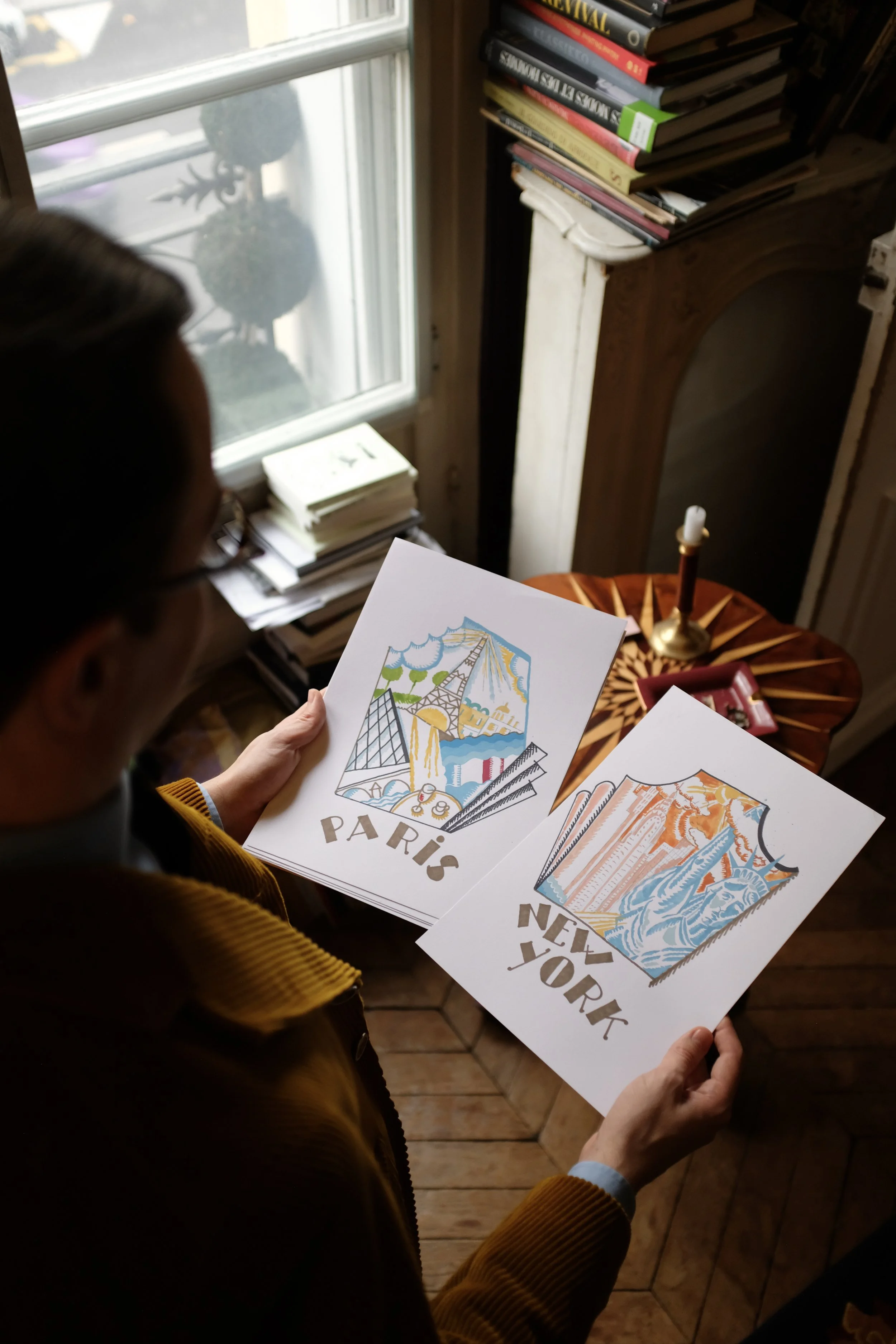
The prints I have hanging on the wall in my studio depict rows of gentlemen dressed in the fashion of 1820 to 1840. With their sideburns, top hats or bicorns, tailcoats, and walking sticks, they all look at me anonymous and serene, smiling and vacant. Paper figurines describing a virile world made of elegance, exasperated refinement, and perpetual festivity. These paper gentlemen used to gather in their clubs, play cards, smoke, and drink until unconscious, sans soucis, sans problèmes. Their sensitivity to the transitory things of life (their very existence, if they ever existed, was ephemeral) spurs the undersigned to continue being interested in the beauty of the world that remains and not to dwell on the ugliness of the world to come.
THE SIGNATURE STEP
What is the small, daily ritual that makes you feel instantly well-dressed or put-together and the one thing that completes your look du jour?
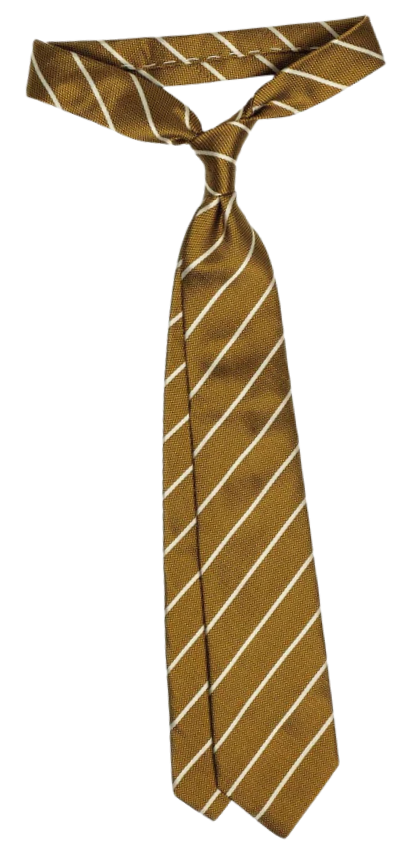
I never go out without a tie (except in very specific contexts). A tailored suit, a fresh shirt every day, and a tie (chosen from among the 80 ties that crowd my wardrobe) are sufficient to make me feel fit and ready for adventure. Even if I remain motionless, leaning against the bar, the idea of being part of the establishment's decoration rather than the city's makes me feel as proud to be alive as a fountain or an avenue of flowerbeds.
LEISURE & L'INSPO
How do you integrate aimless wandering or quiet observation into your creative process? Which street, in any city, is your favorite for an aimless stroll or flânerie?
I often go out with a notebook to write or draw. This does not mean I use it or that I actually draw the things I see on the street. I do not have the spirit of a reporter, nor of a veriste à la Zola. The liveliness of the city world is enough to get ideas circulating. That is why I prefer lively neighborhoods, elegant restaurants (but not expensive ones), and I adore terrasses, a brilliant Parisian invention that allows boulevardiers to expose themselves and observe at the same time. I stroll with pleasure along rue de Rivoli (up to Galignani's windows), while in Turin, my hometown, I stay around Piazza Castello. In Rome, I wander around via dell'Agnello so as to observe the latest Vatican fashions. And in Antwerp, whose historic center is not yet as degraded as that of sad Brussels, I stroll with pleasure through Kloosterstraat and its antique dealers. But the creative process remains within me, a bit like those landscape painters who used to wander through the countryside with their hands in their pockets and then paint immense landscapes once they were back in their studio.
L’OBJET DU DÉSIR
What have you had your eye on lately?
The color of the walls in painter Gustave Moreau's atelier. It is a very particular antique pink, and I would like to repaint the living room in the same pink. You will agree with me that this is a very modest desire, but what can I say, that is how I am. As another saintly boulevardier, Oscar Wilde, used to say, simple pleasures are the refuge of complicated people.
L’ART OF JOY
What is happiness to you? Do you find your truest sense of joie de vivre in your work, your relationships, or your passion projects?
Happiness is managing to get the most out of a precise moment in time and space. Therefore, happiness is a perfectly transitory state of mind. But not unreliable. Pleasure is always there lurking; you just need to know how to uncover it, like a pheasant. My joie de vivre is linked above all to my human and romantic relationships. Without balance in the world of affections, it is difficult for me, if not impossible, to find joy in the rest of things (artistic, professional, etc.). I am a social animal, but despite myself.
“QUOI DE NEUF ?”
What’s inspiring you lately or something you’re excited about?
The printed shirts worn by Paul Poiret and the printed shirts worn by Jacques de Bascher. Not being able to find the same patterns or fabrics, I have the firm intention of designing and having new ones printed, to my taste, but not only for my personal pleasure.
LAST CALL
In the spirit of The Boulevardier tradition, leave us with a drink and a song.
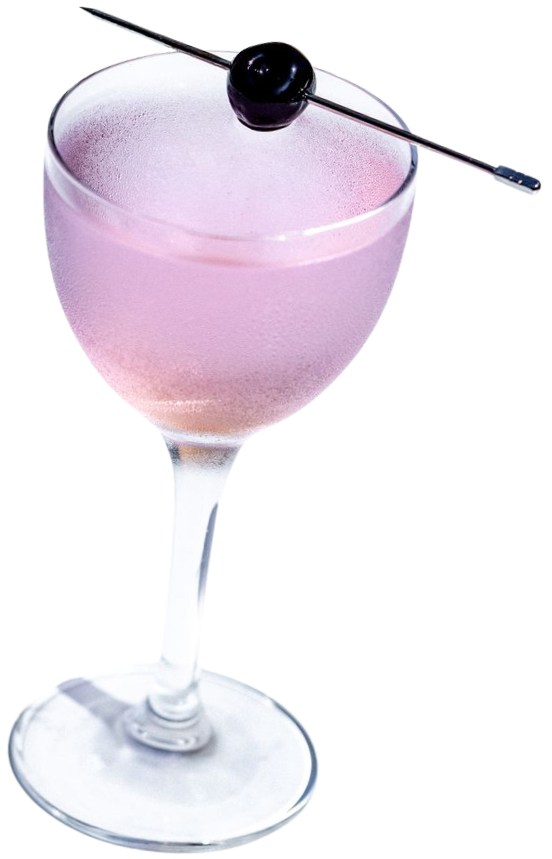
My drink is the Aviation. Gin, maraschino, lemon, and crème de violette. It has an absurd and very gay color, and if consumed in adequate doses, it gives all the symptoms of drunkenness (cit..). Crème de violette is difficult enough to find that obtaining one at the bar is a rare pleasure to be savored with a certain depth of reasoning.
For the song, I opt for “On the Morning After” (text and music by Fiorenzo Carpi, sung in the film Salon Kitty). Among many good songs for intoxication and debauchery, I like listening to this one, excellent for the gueule de bois:
They say that all things
must have an end,
that broken bones
and broken hearts
take oh so long to mend.
You’ve heard it so often,
it must be true.
Will you believe it
when it happens to you?
Your morning coffee
won’t taste the same.
A fix won’t help a lot,
you’ve only got
yourself to blame.
Your bed so empty,
your world so black.
Is there no joy,
is there no love,
is there no turning back?
Your life’s in pieces.
what can you say?
As you light yet
another cigarette
thoughts far away.
With sleepless eyes
you realize
it’s not the same world as before,
On the morning after the night before.
As told to Patrick Dooley